SM BUYER PLAYBOOK · VOL. 01 · 2026
Compactor Shelving TCO Playbook 2026: The 7 Specifications That Quietly Decide Your 10-Year Cost
Most compactor shelving RFQs we receive in 2026 are scored on one number: price per bay. After 16 years of exporting mobile archive racks to 40+ countries, we can tell you — that single number is the most overrated line item on the whole quote. The real money is buried in seven specifications most buyers never read past the cover page. This playbook walks through each of them.
The Hidden Math: Why "Cheap" Bays Become "Expensive" Archives
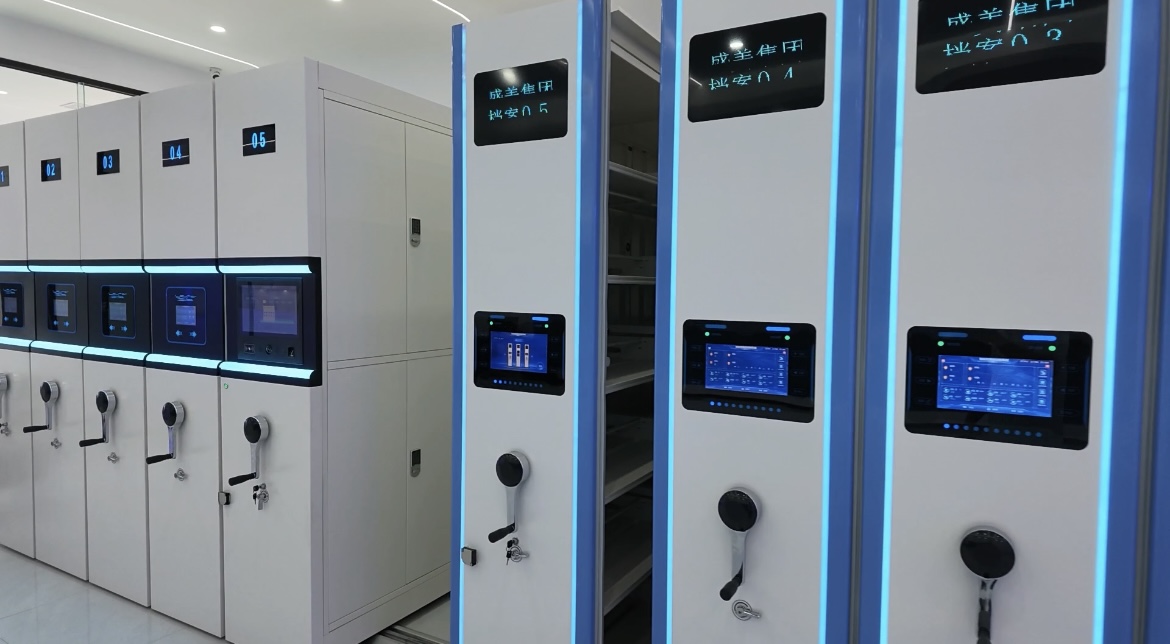
If you Google compactor shelving price you will see quotes ranging from roughly USD 180 to USD 1,200 per bay for what looks like the same product. Most procurement teams conclude that they are being "marked up" by 6×. They are not. The delta lives in things that don't show up in the cover photo: steel thickness, motor quality, anti-pinch logic, environmental sensors, software export, certified standards, and after-sales coverage.
Pull the spreadsheet out ten years. Add the realistic numbers:
- Annual maintenance: 1.5–4% of capex, every year (industry standard for capital equipment — see Wikipedia: Mobile shelving for the technology definition and lifecycle context).
- Spare parts: motors, sensors, control boards, lock cylinders. Budget 8–12% of capex over the 10-year horizon.
- Downtime cost: a single jammed carriage in a 12-bay archive can block a 6-person records team for a half-day. At fully-loaded labour cost, that is USD 400–1,200 per incident.
- Energy: a 30-bay intelligent block running 8 hours/day consumes ~1,800 kWh/year. Small number, big surprise on the utility bill.
- Insurance & compliance: certified anti-pinch and fire-resistant systems can shave 10–30 bps off property premiums. Non-certified ones cannot.
If you only optimise the capex line, you will end up paying for the operating cost — with interest. Here are the seven specifications we tell our own customers to score instead.
Specification #1 — Steel Gauge, Track, and Structural Integrity
SPEC 01Frame, Chassis, and Rail Steel
What to ask for in writing: the cold-rolled steel thickness of the chassis, the side panel, the rail, and the wheel groove. A serious supplier will answer in millimetres within one email.
What the difference means: 1.0 mm side panel vs. 1.2 mm side panel is invisible in a quote but adds roughly 18% to the lateral rigidity — which decides whether the rack warps after five years of being shoved open and closed three hundred times a day.
Shengmei reference benchmark: 20×20 mm solid square steel track, 3.0 mm cold-rolled steel chassis, ≥1.0 mm cold-rolled side panel, dust-proof top board, rat guards, and anti-tilting device at the bottom. Verified by ISO 9001 / ISO 14001 / ISO 45001 certified production lines.
Specification #2 — Drive System Architecture (Manual / Electric / Intelligent)
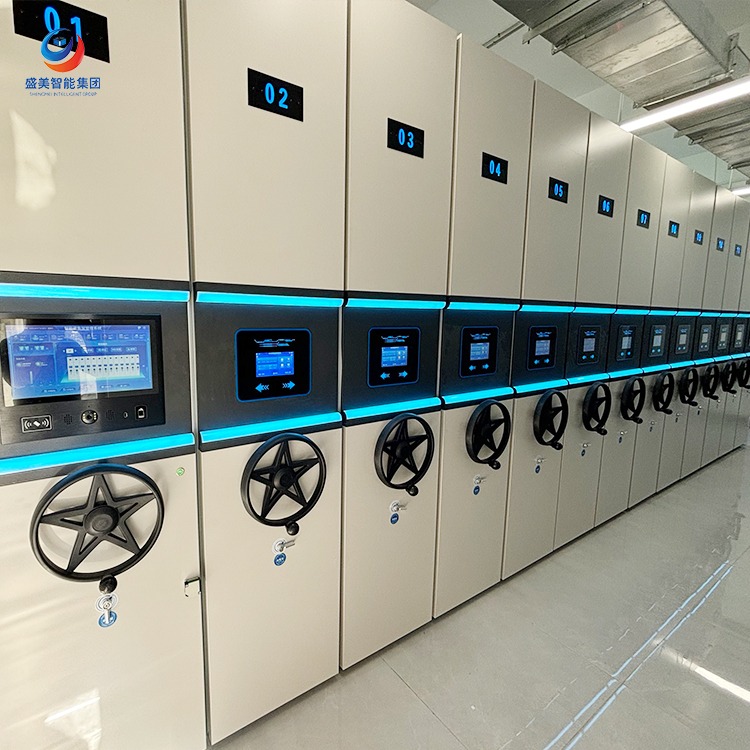
This is the single line item where the smart-money mistake happens. Buyers assume "manual" = "low-tech but cheap", and "intelligent" = "expensive but worth it." The honest answer is more nuanced:
| Drive type | Best fit | Real productivity gain | Hidden cost |
|---|---|---|---|
| Manual (hand crank) | ≤30 bays, low access frequency, no power supply on site | Baseline | Labour cost per access |
| Electric (motorised, no DB) | 30–80 bays, mid access frequency, mixed staff skill level | +30–50% throughput | Motor replacement at year 6–8 |
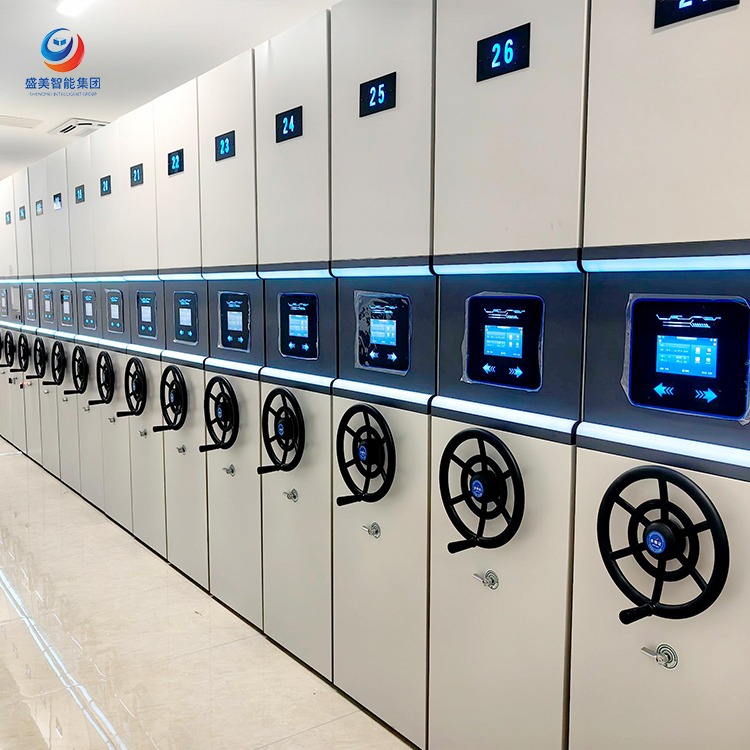
| Intelligent (touch + DB + sensors) | 80+ bays, regulated industries, audit trails required | +80–150% throughput | Software licence & integration |
The wrong call is the most expensive one. A 200-bay courthouse records room running on manual cranks does not save money — it just pushes the cost onto the archivists' hours, which the audit office will eventually flag. Conversely, a 15-bay HR storage room running intelligent control has paid for its premium in about 14 months. Always match drive type to bay count and access frequency, not to budget ceiling.
Specification #3 — Anti-Pinch & Multi-Layer Safety Logic
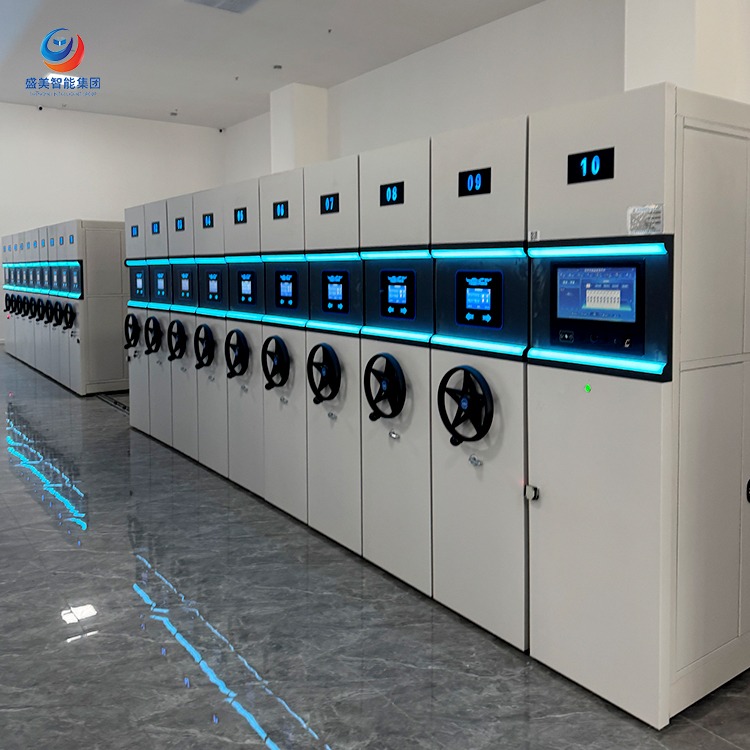
Anti-pinch sounds like a feature until you read the underlying machine-guarding logic. The reason it is on this list: an anti-pinch alarm that does not lock the carriage is not anti-pinch, it is a buzzer. A real system has at least five layers: infrared fence, mechanical anti-squeeze bar, motor current spike detection, photo-electric curtain, and a manual emergency stop that physically cuts power.
Ask the supplier for a failure-mode matrix. If they cannot produce one, walk away.
SAFETYThe 5-layer stack to insist on
- Infrared fence at the aisle mouth (triple-beam is the new minimum, single-beam is 2012 spec).
- Anti-squeeze strip on the moving column face.
- Motor current feedback — when the load jumps 30% above baseline in <200 ms, the controller must cut drive within 80 ms.
- Soft start / soft stop to avoid racking the rails and shaking the archives off the top shelf.
- Physical emergency stop that breaks the 24 V DC bus, not just a software "pause" command.
Specification #4 — Environmental Sensing Stack (Temp, Humidity, PM, TVOC)
Paper archives degrade. The killers are well known: temperature swings, relative humidity outside 30–60% RH, particulate matter (PM1.0 / PM2.5 / PM10), CO₂, formaldehyde (CH₂O), and total volatile organic compounds (TVOC). The U.S. National Archives' records management guidance is the clearest plain-English version of this on the public web — bookmark archives.gov/records-mgmt if you are specifying a new facility.
Most "smart" compactor shelving in the market today ships with one or two sensors. That is not enough. A 2026-grade spec is:
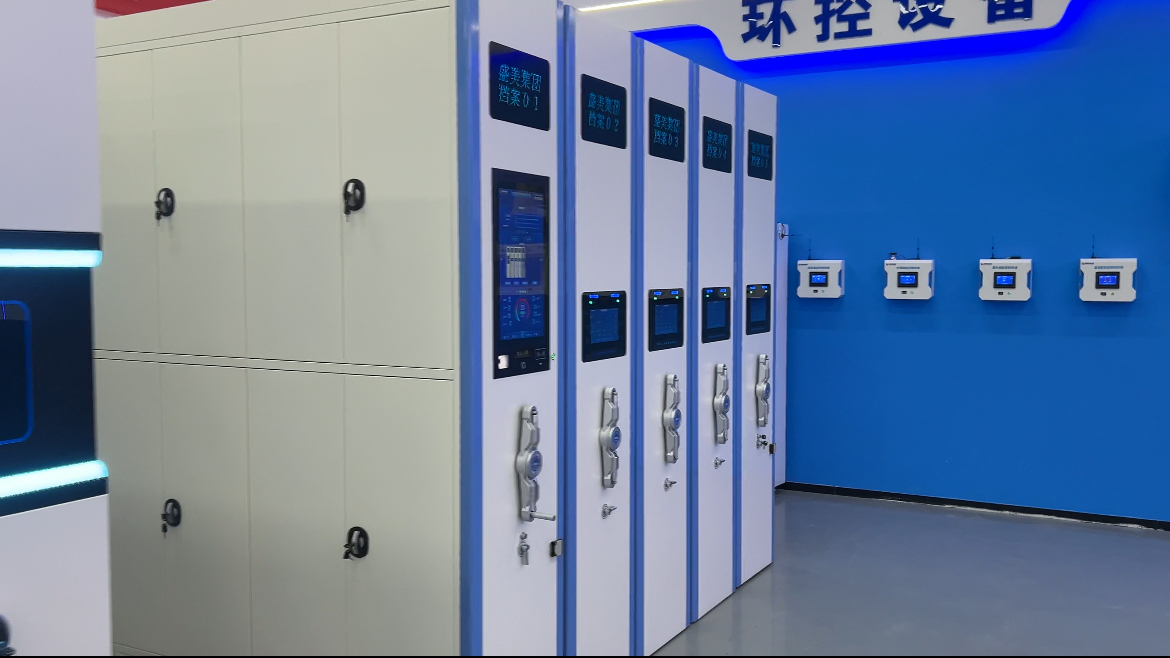
- 8 environmental channels: temperature, RH, PM1.0, PM2.5, PM10, CO₂, CH₂O, TVOC.
- Real-time logging with exportable CSV, not a screen-only display.
- Threshold-based automatic response — when RH crosses 65%, the system should fire the dehumidifier without human intervention.
- Per-zone calibration — top shelves in a heated archive room run 2–3°C warmer than the floor; one sensor in the middle of the room is not acceptable.
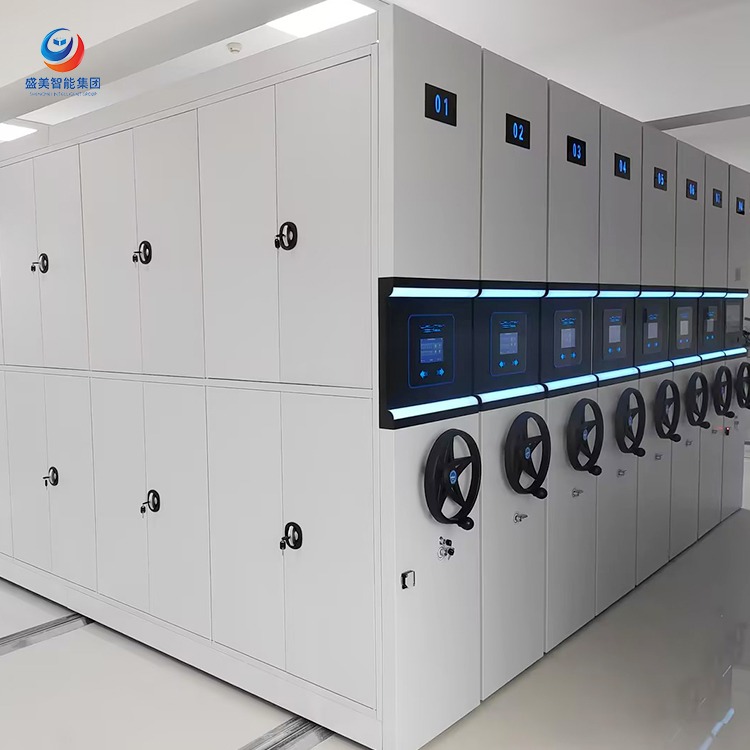
This is also where internal content on our site goes deeper. If you want the long-form treatment of how intelligent temperature and humidity monitoring protects paper archives, we have a separate guide on that: "Smart Temperature and Humidity Monitoring: How Compactor Shelving Protects Valuable Archives."
Specification #5 — Software Integration & Data Export
If your compactor shelving cannot talk to the rest of the building, you have bought a very expensive filing cabinet with a screen. In 2026, the minimum bar for an intelligent compactor shelving system should be:
- 3× USB ports + 1× Ethernet + WiFi on the fixed-side master panel.
- Open database export — the archive location log should be downloadable as CSV or pushed to SQL/MySQL. No proprietary lock-in.
- Barcode / RFID read rate >99.9% — anything less means your staff will re-key the missing 0.1% by hand and lose the time savings.
- Two-way communication between master PC and mobile carriages. The carriages must report their position back, not just receive instructions.
- User-level access control with audit trail — who opened which bay, when, and for how long. This is non-negotiable for any regulated archive (legal, medical, financial).
The RFID read rate target is not arbitrary. It is the conformance threshold of ISO/IEC 15693 (vicinity coupling smart cards — the family most modern archive RFID tags belong to). If a supplier claims "RFID-enabled" but cannot name the standard they are conforming to, you are looking at marketing copy, not a specification.
Specification #6 — Certified Standards (the ones that actually matter)
Every compactor shelving supplier will tell you they are "ISO certified." That sentence is meaningless on its own. The question is which standards, and which clauses. Here is the short list we treat as procurement-grade:
| Standard | What it actually certifies | Why it matters in a 10-year TCO model |
|---|---|---|
| ISO 9001 | Quality management system at the factory | Predictable defect rate; supports warranty claims |
| ISO 14001 | Environmental management system | Required for ESG disclosures and EU public-procurement bids |
| ISO 45001 | Occupational H&S management | Required for installation crew site safety in most jurisdictions |
| ISO/IEC 15693 | RFID interoperability | Future-proofs your tag fleet across vendors |
| ISO 18000-3 | RFID air-interface at 13.56 MHz | Required for the read-rate target in spec #5 |
Specification #7 — After-Sales: Service Network, Spare Parts, Software Updates
Spec #7 is the one that is invisible at quote time and decisive at year four. Ask the supplier five questions in writing:
- How many field service engineers are based within 500 km of our installation site?
- What is the guaranteed on-site response time for a carriage-down event during business hours?
- What is the price and lead time of a replacement motor, control board, and touch screen five years from now?
- How long are software updates and security patches committed for the controller firmware?
- Is the user manual and electrical schematic delivered in our language, and is remote diagnostic support included?
Pen these into the purchase contract, not into a sales deck. A 10-year TCO model with no service SLA is fiction.
The 10-Year TCO Comparison — Three Scenarios, Real Numbers
To make the seven specs tangible, here is a worked example for a hypothetical 60-bay archive room in a mid-size financial services firm. Numbers are conservative mid-market estimates; your mileage will vary by region and access frequency.
| Cost line (USD, 10-year horizon) | Manual (SM-SD) | Electric | Intelligent (SM-ZN-MJJ) |
|---|---|---|---|
| Initial capex (60 bays) | ~28,000 | ~46,000 | ~78,000 |
| Installation & commissioning | 3,500 | 5,000 | 8,000 |
| Energy (10 yr) | 0 | 4,500 | 6,200 |
| Maintenance (avg 2.5%/yr) | 7,000 | 11,500 | 19,500 |
| Spare parts | 2,800 | 5,200 | 8,400 |
| Labour cost of access (downtime, error re-keying) | 54,000 | 32,000 | 11,000 |
| Insurance & compliance discounts | 0 | −1,500 | −4,000 |
| 10-year TCO | ~95,300 | ~102,700 | ~127,100 |
| TCO per bay per year | ~159 | ~171 | ~212 |
Two non-obvious takeaways:
- Manual is cheapest only when access frequency is low (<15 accesses/day). Above that, intelligent wins on labour savings within 3 years.
- The gap between manual and intelligent on a per-bay-per-year basis is only ~33%. That is far less than the 2–3× capex multiple, because most of the lifetime cost is labour, not hardware.
Where Most Procurement Teams Go Wrong (and How to Avoid It)
Across the 40+ countries we export to, we see five recurring mistakes:
Mistake 1 — Single-line item comparison
Comparing "Bay A: USD 380" against "Bay B: USD 520" without reading the steel, motor, and control specs. The cheap bay is not the cheap bay.
Mistake 2 — Ignoring ventilation and humidity
A 60-bay block seals 100 m² of paper air. Without dehumidification, mould wins within 18 months. The 8-channel sensor is not a luxury; it is insurance.
Mistake 3 — Skipping the control board export
If the system cannot export your archive log to CSV/SQL, you are locked in to that vendor for the controller's entire lifecycle. That is 10+ years of vendor dependency.
Mistake 4 — Treating the SLA as a sales artefact
Service-level commitments written into a sales deck evaporate at year three. The ones written into the purchase contract survive. Always re-read the SLA before signing the PO.
Mistake 5 — Specifying the room after the rack
Floor load, ceiling clearance, ventilation ducts, and fire suppression must be locked before the bay count is finalised. Reversing this order is the single most expensive mistake in archive construction.
What to do instead
Score every quote on a weighted TCO rubric — 30% capex, 25% steel & safety, 20% software, 15% environmental, 10% service. The cheapest quote almost never wins. The most defensible quote does.
The 12-Point Compactor Shelving Procurement Checklist
Print this. Tape it to the procurement office wall.
- Track: 20×20 mm solid square steel, ≥3.0 mm wheel groove plate — written, not verbal.
- Chassis: ≥3.0 mm cold-rolled steel plate. Side panels: ≥1.0 mm.
- Anti-pinch: 5-layer stack (IR fence + mechanical strip + motor current + photo curtain + e-stop).
- Environmental sensors: 8 channels minimum — temperature, RH, PM1.0/2.5/10, CO₂, CH₂O, TVOC.
- Drive type matched to bay count and access frequency (manual ≤30 bays, electric 30–80, intelligent 80+).
- Communication ports: ≥3× USB, 1× Ethernet, WiFi.
- RFID conformance to ISO/IEC 15693 and ISO 18000-3, with read rate >99.9%.
- Open database export (CSV / SQL). No proprietary lock-in.
- Certifications on file: ISO 9001, ISO 14001, ISO 45001.
- User-level access control with full audit trail.
- On-site service SLA: response time, spare-parts price commitment, firmware update horizon.
- Floor load, ceiling clearance, ventilation, and fire suppression pre-engineered before bay count is finalised.
How Shengmei Scores on the 12-Point Checklist
We do not claim to be the cheapest. We do claim to be the lowest TCO at the 10-year mark for facilities with 30+ bays and any kind of access frequency above 10/day. The full intelligent compactor shelving product line ships with all 12 of the above as standard. So does the manual line for everything except items 4, 6, 7, 8, 10 — which are physical impossibilities on a hand-crank system, not a Shengmei limitation.
Frequently Asked Questions
How long does a compactor shelving system actually last?
Industry service life for a well-built cold-rolled steel compactor shelving system is 15–25 years, with one major motor overhaul around year 8–10. The control electronics typically refresh on a 7–10 year cycle. This is the kind of lifecycle data that should be in the supplier's written warranty, not in a slide deck.
Is intelligent compactor shelving worth the premium for small archives?
Honestly, no — for fewer than 30 bays with low access frequency, manual is the right call. The premium pays back above ~30 bays or above ~15 accesses/day. The "intelligent everything" pitch is a trap for sub-scale facilities.
What floor loading do I need to budget for?
A fully-loaded 6-layer bay in the SM-SD / SM-ZN-MJJ family weighs roughly 800–1,200 kg per running metre. Most commercial-grade floor slabs in archive-grade buildings (≥4 kN/m²) handle this without reinforcement. Older buildings may need a structural review — that goes on the checklist, not on the supplier's quote.
Can I retrofit a manual system with intelligent control later?
Sometimes, but rarely cleanly. The control harness and motor mount points are designed in from the steel stage. Retrofitting usually means a 30–40% cost premium over buying intelligent from day one, plus 1–2 weeks of archive downtime. The right move is to future-proof the spec at purchase: buy the chassis pre-wired for the intelligent kit even if you only install the manual drive on day one.
How do I evaluate a compactor shelving supplier for a public-procurement bid?
For government and public-sector bids, the shortlist should include: (a) documented ISO 9001/14001/45001 certificates, (b) at least 3 reference projects in your country you can physically visit, (c) a bank-line and credit rating, and (d) a written 10-year spare-parts commitment. Price is the tiebreaker, not the first filter.
Get the Full TCO Worksheet for Your Project
Want a 10-year TCO model built around your actual bay count and access pattern?
Send us your room dimensions, bay count, and approximate daily access volume. We will return a side-by-side TCO worksheet comparing manual, electric, and intelligent compactor shelving for your specific site — no obligation, no sales call required.
Email the Editorial Team WhatsApp Kerwin (+86 189 3280 1260)Disclosure: This article is published by SHENGMEI Cabinet (Hebei Shengmei Intelligent Group Co., Ltd.), a manufacturer and exporter of mobile archive storage equipment with 16+ years of production experience and customers in 40+ countries. The TCO figures in this article are conservative mid-market estimates derived from publicly available industry data and from our own export project records between 2018 and 2025; they are illustrative, not a quote, and your results will vary by region, labour cost, and access pattern.